China Launching "Global Gold Exchange" In Shanghai

Tue, May 27 2014, 10:51 GMT
Today’s AM fix was USD 1,283.00, EUR 940.48 and GBP 762.87 per ounce.
Yesterday, U.S. & UK markets were closed yesterday for a national holiday.
Friday’s AM fix was USD 1,292.00, EUR 948.61 and GBP 767.18 per ounce.
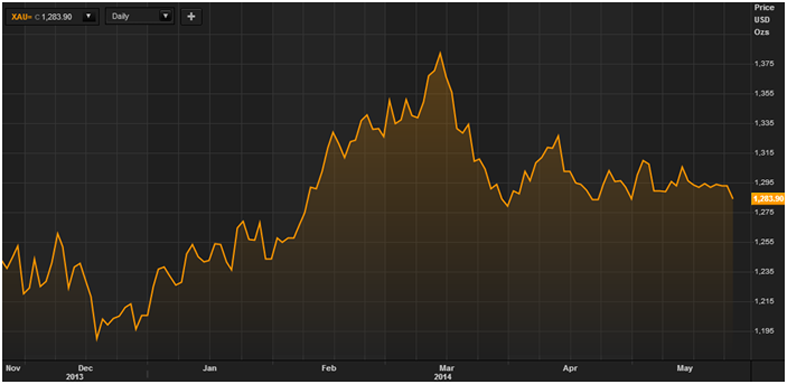 Gold in U.S. Dollars, Daily, 6 Months - (Thomson Reuters)
Gold is testing the lower level of support of the unusually tight range seen
in recent days between $1,284/oz and $1,306/oz. Below that the next level of
support is at $1,250/oz and below that the low seen on December 31st at
$1,190/oz. Overnight,
gold
in Singapore gradually traded lower from a high of $1,293/oz to a low of
$1,282.81/oz.
The price weakness comes despite continuing bullish developments for the
gold market. These include geopolitical risk as Ukraine lurches into a
civil war, tensions between Vietnam and China in the Far East and China’s push
to make Shanghai a “Global Gold Exchange.”
Ukraine launched air strikes and a paratrooper assault against pro-Russian
rebels who seized an airport on Monday. Its newly elected leader rejected any
talks with "terrorists" and said a robust military campaign in the
east should be able to put down a separatist revolt in "a matter of
hours".
Even as the fighting was getting under way, Poroshenko held a news
conference in Kiev and said that the government's military offensive
needed to be "quicker and more effective".
A Vietnamese fishing vessel capsized in disputed waters in the South China
Sea on Monday after "harassing and colliding" with a Chinese fishing
boat, the official Xinhua news agency said on Tuesday.
China has approached foreign banks and gold producers to participate in a
global gold exchange in Shanghai, as the world's top producer and importer of
gold seeks greater influence over pricing and the global gold market.
 Shanghai Gold Exchange - China Foreign Exchange Trade System
The Shanghai Gold Exchange got the go ahead from the central bank last week
to launch a global trading platform in the city's pilot free trade zone. SGE is
looking to launch physical contracts of gold, silver and platinum group metals
denominated in Chinese yuan on the international exchange.
According to Reuters:
“For gold, they are looking to launch three yuan-denominated physical
contracts, of 100 grams, 1 kg and the bigger London good delivery bar weighing
12.5 kg.
Beijing's plans to open up gold trading comes at a time when the benchmark
price-setting process for precious metals is under scrutiny. Barclays Plc
became the first bank to be fined over manipulation of the 95-year-old
benchmark London gold market daily "fix" last week.
State-backed SGE has asked bullion banks such as HSBC , Australia and New
Zealand Banking Group (ANZ), Standard Bank, Standard Chartered and Bank of Nova
Scotia to take part in the global trading platform, two people approached by
the exchange said.
SGE, the world's biggest physical gold exchange, where domestic banks,
miners and retailers buy and sell gold, could also open up the international
platform to foreign brokerages and gold producers, they said.
"China wants to have more voice in gold prices," said Jiang Shu,
an analyst with Industrial Bank, one of 12 banks allowed to import gold into
China. "The international exchange is the first step towards gaining a say
in gold pricing."
"If you don't allow foreign players to participate in your market actively,
or do not push Chinese financial institutions to participate in the
international market, then China's strong gold demand is only a number, not a
power," he said.
HSBC and Standard Bank declined to comment, while the other banks and SGE
were not immediately available for comment.
The global platform will first host spot physical contracts for gold and
other precious metals, before aiming to launch derivatives down the line, said
a third source who is directly involved in the launch of the international
exchange.
"We are not just encouraging foreign banks but also producers and other
entities," added the source.
China, the world's biggest buyer of raw materials from copper to coal, is pushing
hard to establish pricing benchmarks for a number of commodities.
Gold, along with oil, could be among the first to be opened up to foreign
players. The free trade zone in Shanghai is set to see international energy
trading by hosting the country's first crude oil futures.
Contract specifications for silver, platinum and palladium were also being
discussed, though the sources said specifications and participants had not yet
been finalized. The exchange is expected to be launched by the fourth quarter.
Even if China lures foreign players, the exchange would still need to see
full convertibility of the yuan and enough liquidity on the exchange before it
can be considered to operate on a par with other hubs.
Currently, the London gold "fix" is the benchmark for spot prices,
while New York's COMEX contract sets the futures' benchmark. SGE prices are
tracked to gauge Chinese demand as reflected in premiums or discounts to spot
rates.
Earlier this year, China's ICBC - in conjunction with its acquisition target
Standard Bank - indicated interest in buying Deutsche Bank's seat on the London
gold fix but it is not interested anymore, sources previously told Reuters.
The influx of gold has made SGE the biggest physical exchange, with a
turnover of 10,000 tonnes for its immediate and deferred delivery contracts,
according to Thomson Reuters GFMS.
The Shanghai Futures Exchange has the world's second-most traded gold
futures contract, though trading is largely limited to the domestic market with
volumes of about 41,176 tonnes last year, still well behind COMEX's 147,083
tonnes.
The SGE's international board and the main exchange could eventually be
merged when the yuan is fully convertible, Albert Cheng, managing director of
the World Gold Council's far east region, said.
"That would become a very important exchange in the world, and Shanghai
will truly become one of the three international gold centres after New York
and London," he said. "No doubt, the participation in the
international market is the key effort of the SGE and the current
administration."
Read the full story
here.
Conclusion
Banks, global producers, refineries and mints will be hesitant to embrace
the new Chinese exchange, especially in the short term. However, once the new
exchange achieves critical mass in China and Asia, the exchange will be
embraced by western institutions and could become the most important gold
exchange in the world.
The move will challenge the dominance of New York and London as global
precious metal hubs, as centres of the gold trade. It will also challenge their
influence on pricing. Physical demand provides underlying support to gold
prices and ultimately dictates the price. Speculative trading and
manipulation can and has affected prices in the short term.
With China's push for an international physical exchange, physical demand
will begin to have a stronger influence, thereby ending
gold
manipulation. This will allow gold to rise to a more appropriate price
given the scale of macroeconomic, systemic, geo-political and monetary risks of
today.