Friday, January 16, 2015

A New Civil Rights Movement Frees Our Communities from Corporate Control


Picture


In their latest victory a Pennsylvania Judge holds that corporations are not persons


by Thomas Alan Linzey 

To protect small and family farms from industrial factory farming, over a decade ago a handful of Pennsylvania townships stood up to some of the country’s largest agribusiness corporations. Recognizing that the state and federal government, rather than protecting them from factory farms, were in fact forcing them into communities, the townships took the unprecedented step of banning corporate farming within their borders.

Thus began the journey to spark a new civil rights movement – one aimed at elevating the right of communities over the ‘rights’ of corporations to use communities for their own ends.

In a departure from the usual David and Goliath story, with one tiny community battling a giant corporation, today there are over 150 “Davids” in eight states that have followed the lead of those Pennsylvania townships. Community by community, they’ve banned corporate “fracking” for shale gas, factory farming, sludge dumping, large-scale water withdrawals, and industrial-scale energy projects.

However, they’re not intent on simply stopping the immediate threat of fracking or factory farming. Rather, they’re adopting Community Bills of Rights that ban such projects as violations of the community’s right to a sustainable energy and farming future. And to protect those Bills of Rights, they are legislatively overturning a slew of corporate legal doctrines – like corporate ‘personhood’ – that have been concocted over the past century to keep communities from interfering with corporate prerogatives.

These communities believe that if ten thousand other localities do the same, that those tremors will begin to shake loose a new system of law – a system in which courts and legislatures begin to elevate community rights above corporate rights, and thus, begin to liberate cities and towns to build economically and environmentally sustainable communities free from corporate interference.

Last week, a Pennsylvania county court gave this new movement a boost – declaring that corporations are not ‘persons’ under the Pennsylvania Constitution, and therefore, that corporations cannot elevate their ‘private rights’ above the rights of people.

The ruling was delivered in a case brought by several Western Pennsylvania newspapers which sought the release of a sealed settlement agreement between a family claiming to be affected by water contamination from gas fracking, and Range Resources – one of the largest gas extraction corporations in the state. Range Resources argued that unsealing the settlement agreement would violate the corporation’s constitutional right to privacy under the Pennsylvania Constitution.

In a landmark ruling, President Judge Debbie O’Dell-Seneca of the Washington County Court of Common Pleas denied the corporation’s request on the basis that the Pennsylvania Constitution only protects the rights of people, not business entities.
Judge O’Dell-Seneca cited that Article I of the state Constitution, which reads, “All men are born equally free and independent,” cannot apply to them.

“There are no men or women defendants in the instant case; they are various business entities. ... These are all legal fictions, existing not by natural birth but by operations of state statutes. ... Such business entities cannot have been ‘born equally free and independent,’ because they were not born at all.”

The court records unsealed by the ruling reveal that the gas extraction corporations paid out $750,000 to settle claims of water contamination caused by fracking. The ruling is significant because the fracking companies have relied on secrecy agreements with landowners to hide the environmental and health impacts of gas drilling.

The ruling represents the first crack in the judicial armor that has been so meticulously welded together by major corporations. And it affirms what many communities already know – that change only occurs when people begin to openly question and challenge legal doctrines that have been treated as sacred by most lawyers and judges.

Today, a revolution that places the rights of people and nature above the rights of corporations is in the process of emerging. Will your community join in?


Thomas Linzey is the executive director of the Community Environmental Legal Defense Fund, which has helped 150 communities in eight states adopt Community Bill of Rights to limit corporate powers.

Community Environmental Legal Defense Fund
celdf.live2.radicaldesigns.org
Tel. 717.498.0054

Why Sharing News about Solutions Is a Revolutionary Act

Why Sharing News about Solutions Is a Revolutionary Act

Picture
Scary stories of kidnappings and explosions lead our news feeds,
but it’s the good news that helps break down the myth of our own powerlessness


by Frances Moore Lappé

“If it bleeds, it leads.” Ever hear that maxim of journalism? If you want readers, go with the scary, gruesome story—that’s what gets hearts pumping and grabs attention. But what grabs our attention can also scare the heck out of us and shut us down.

Scary news might “sell,” but we can also feel so bombarded with the negative that our “why bother?” reflex kicks in. Fear stimuli go straight to the brain’s amygdala, Harvard Medical School’s Srinivasan Pillay explains. But, he adds, “because hope seems to travel in the same dungeons [parts of the brain] as fear, it might be a good soldier to employ if we want to meet fear.”

So let’s get better at using hope. It’s a free energy source

Hope isn’t blind optimism. It’s a sense of possibility—the delight in the new and joy in creativity that characterizes our species. So let’s break the good-news ban and become storytellers about real breakthroughs. I’m convinced that in the process, we will strengthen our capacity to incorporate and act on the bad news as well.

After all, it’s only in changing the small stories that we change the big, dangerous story—the myth of our own powerlessness. Remember, what we do and say doesn’t just influence our friends, but also our friends’ friends and our friends’ friends’ friends (yes, research shows it goes three layers out). That’s power! Here are some recent items that have made my day.

1. Renewables ramping up

With news of Keystone and tar sands and coal-crazy China, it’s easy to think that renewable energy is going nowhere, but we’d be wrong. Between 2008 and 2012, the U.S. nearly doubled its renewables capacity.

And in the first three months of this year, 82 percent of newly installed domestic electricity-generating capacity was renewable. Plus, installed capacity of new solar units during the first quarter of this year is more than double that of same period last year.

Globally, 13 countries now get 30 percent or more of their electricity from renewable sources.

Germany, which is slightly smaller in size than Montana, produced about half the world’s solar energy technology. That could depress us, or, it could remind us of the vastness of untapped potential.

In April, at the first Pathways to 100% Renewables Conference in San Francisco, I heard scientists declare that there’s absolutely no technical obstacle to our planet’s reaching 100 percent renewable energy in a few decades.

Abetting the process, the cost of renewables is plummeting worldwide—that of electricity from large solar power plants fell by more than half, from 31 cents per kilowatt-hour in 2009 to 14 cents in 2012.

2. Wind wows

Denmark’s wind energy alone provides about 30 percent of the country’s electricity, making it the world leader in wind power. And U.S. wind power? We’re second only to China among the world’s wind energy producers, with wind power equal to about 10 nuclear power stations or 40 coal-fired power stations.

Growing up in oil-centric Texas, I would have been the last person to predict my home state’s leadership. But in the 1990s eight utility companies brought groups of citizens together to learn and to think through options.

By the end of the process, they’d ranked efficiency higher than when they began, and the share of those willing to pay for renewables and conservation increased by more than 60 percent. Apparently, the utility companies listened: If Texas were a country, it would now be the world’s sixth ranking wind energy producer.

3. Cities, states, countries pledge to go green

Eight countries, 42 cities, and 48 regions have shifted, or are committed to shifting within the next few decades, to 100 percent renewable energy in at least one sector (like electricity, transportation, or heating and cooling).

In California, the cities of San Francisco, Lancaster, and San José have officially set their goal at 100 percent renewable electricity within the next decade. And if you’re thinking, “Oh yeah, that’s just California”: Greensburg, Kan., set its goal at 100 percent renewable power for all sectors after the town was wiped out by a tornado in 2007.

Colorado’s target is 30 percent renewable electricity by 2020, a standard that’s helped spur success—especially when it comes to wind. And Vermont’s energy plan is set to get the state to 90 percent renewable energy in all sectors by mid-century.

And whole countries?

Iceland already gets 100 percent of its electricity from renewables—three-quarters from large hydro and 25 percent from geothermal.

In Costa Rica, it’s about 95 percent—mainly from hydroelectric, along with wind, biomass and geothermal.

Monaco, Norway, New Zealand, and Iceland are all aiming to become the first carbon-neutral country. And Ethiopia unveiled plans to become a middle-income carbon-neutral country by 2025.

4. Forests forever

In India, ten million families take part in roughly 100,000 “forest-management groups” responsible for protecting nearby woodlands. Motivation is high, especially for women, because firewood still provides three-fourths of the energy used in cooking.

Working collaboratively with the Indian government, these groups cover a fifth of India’s forests; and they’re likely a reason that India is one of the few countries in the world to enjoy an increase in forest cover since 2005.

And if you’re not excited yet, try these two final tales

Close to home: Four years ago in Magnolia Springs, Ala., the conservative town government passed the toughest land regulation in the south. It’s spending a quarter million dollars on a comprehensive plan to restore and protect its charming river from agricultural chemical runoff.

“I’m a tree-hugging, liberal—I mean a tree-hugging conservative Republican! Which I know some people may say is an oxymoron,” said Mayor Charlie Houser of this small town near Mobile. Brown pelicans are showing up again, says Houser, and he adds: “Cormorants up in the treetops ... Beautiful sight!”

Around the world: Three-fourths of Niger is desert, and news headlines focus on hunger there. But over two decades, poor farmers in the country’s south have “re-greened” 12.5 million desolate acres.

In all, Niger farmers have nurtured the growth of some 200 million trees—discovering that trees and crops are not competitors but are complementary. The trees protect the soil, bringing big crop-yield increases, and they provide fruit, nutritious leaves, fodder, and firewood. Now young people are returning to villages in Niger, and school kids are learning to care for the trees, too.

Are you willing to step up and be part of the solution?

Neuroscientists tell us our brains are “plastic,” with new neuronal connections being created all the time, forming new “streambeds” in our brains that shape our responses to life. So isn’t actively choosing what shapes our brains perhaps the most powerful way to change ourselves, enabling us to change the world?

Facing unprecedented challenges, we can choose to remain open to possibility and creativity—not mired in despair. Surely, the latter is a luxury that none can afford. We can create and enthusiastically share a solutions story today, and every day. It is a revolutionary act.

More Information:
...........................
Story from Yes! Magazine

Adopted from Ms Lappé’s book:
EcoMind: Changing the Way We Think, to Create the World We Want

Teen Girls from Nigeria Invent a Pee-Powered Generator

Picture
by Beth Buczynski

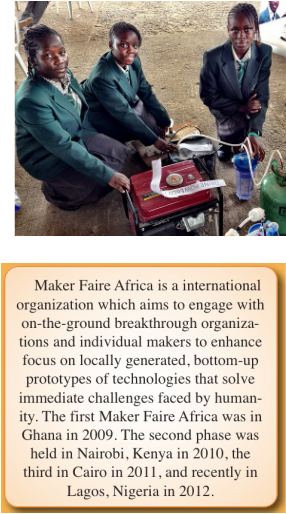
We often assume that revolutionary technological advancements are the stuff of MIT scientists or Silicon Valley entrepreneurs, but that’s not always the case. All it takes to change the world is a good idea and the courage to see it through to fruition. That process is paying off for a group of four African teenagers who’s recent Maker Faire Africa submission is rocking headlines around the world.

The girls are Duro-Aina Adebola (14), Akindele Abiola (14), Faleke Oluwatoyin (14) and Bello Eniola (15), and they all participated in the Maker Faire Africa last November in Lagos, Nigeria.

Reliable electrical power is hard to find in many parts of Africa, and the girls wanted to make something that would be truly useful. Together, they assembled a working generator that’s capable of turning a single liter of urine into 6 hours of electricity.

The average human produces about two liters of urine in a day, so this generator doesn’t require “input” from an entire village. Still, turning pee into clean energy requires more than just a full bladder and a place to put it.

First, collected urine is put into an electrolytic cell, which separates out the hydrogen. The hydrogen goes into a water filter for purification, which then gets pushed into the gas cylinder. The gas cylinder pushes hydrogen into a cylinder of liquid borax, which is used to remove the moisture from the hydrogen gas. The resulting purified hydrogen gas is then introduced to the generator. The girls were sure to include one-way valves to make the process safer, but as the Maker Faire Africa blog points out, there’s definitely risk of explosion.

In addition to that safety issue, there are other reasons why the pee-powered generator is far from market ready. As FastCoExist points out, “The separating of the hydrogen from the urine requires a source of electricity - quite a bit of it. While the ammonia and urea in your urine make it easier to separate the hydrogen than it is to separate hydrogen from water (which is why we can’t use water as a power source) this generator still requires a large power input to work in the first place.”

Still, these teenagers aren’t the only ones who believe human urine could be a valuable source of energy sometime in the future. Scientists have been looking for a way to transform this waste into power for some time. We applaud these innovative young ladies for accomplishing in a couple of days what few have been able to achieve in a laboratory.

More information:
makerfaireafrica.com

Story from EarthTechling.com

Thousands Are Being Freed of Debt by ‘People’s Bailout’

Picture
by Lucy Purdy


New initiative from Occupy movement unites people in mutual support to buy up and write off millions of dollars worth of citizen debts.

 Billed as a ‘bailout of the people by the people’, Rolling Jubilee is calling for online donations in order to buy so-called ‘distressed’ debts, such as student loans or unpaid medical bills. It will then write off these debts, wiping the slate clean for thousands of people who had been struggling with debt burdens.

“Banks sell debt for pennies on the dollar, on a shadowy speculative market of debt buyers who then try to collect the full amount from debtors,” Occupy Wall Street organizer Ed Needham told Positive News. “The Rolling Jubilee intervenes by buying debt, keeping it out of the hands of collectors, and then abolishing it.”

Rolling Jubilee states that while some work within the law, debt collection agencies often unduly hound debtors after purchasing their debts at knockdown prices from the lenders. “The debt industry is a destructive tool of economic oppression and part and parcel of the economic disparity that is fuelling resistance among the 99% around the world,” said Ed.

Organized by the Occupy offshoot and debt activist group Strike Debt, the project launched in New York City past November, with a telethon streamed live on the internet and hosted by performers and activists. Under the banner: ‘We don’t owe them anything. We owe each other everything’, they explained how $25 can abolish around $500 worth of debt and $100 could wipe out $2,000.

At the time of writing, the group has already collected $400,000, which could abolish $8.25 million of debt.

The concept of a jubilee, which has roots in Judaism, Christianity and Islam, describes an event in which all debts are cancelled and those in bondage set free. “It worked in biblical times and can still work today,” said Ed.

“For example, a kind of jubilee happened in Iceland after the 2008 economic crisis. Instead of bailing out their banks, Iceland canceled a percentage of mortgage debt. What these examples show is that debts are just promises which can – and should – be renegotiated or canceled when the circumstances warrant.”

The project has been lauded as one of the most inspiring to come out of the Occupy movement, with Charles Eisenstein, author of Sacred Economics, describing it as ‘a genius move’ for helping de-stigmatize being in debt.

According to Rolling Jubilee, 77.5% of US households are in debt, with a fifth of indebted households using credit cards to pay for basic living expenses, while one in seven US-ers are being pursued by a debt collector and 62% of all bankruptcies are caused by serious illness.
Ed said that while real wages have fallen, the costs of health, housing and education have risen sharply: “Where is the difference supposed to come from? Wall Street has stepped in and made itself essential to providing for the necessities of life – for a price.”

Rolling Jubilee has had an “overwhelming,” public response, something Ed attributes to its simplicity: “This is a project of people helping other people. It’s organized acts of kindness and solidarity, inspiring like-actions and other innovative ways to build a more just and compassionate society. People realize we must come together if we are to change the status quo – there is no other way.”


More Information:
........................
www.rollingjubilee.org

New Leaders for a New Generation

How a bunch of young activists in Colorado have the big power company 
run for cover

Picture
New Era volunteers during voter registration
by Cat Johnson

Have you heard this bit of awesomeness? New Era Colorado, an organization of young activists, is going head to head with a big, corrupt power corporation and making incredible strides to create a clean, publicly owned power company for Boulder, Colorado. In doing so, they are showing how other cities can do the same.

As you can imagine, the power company is not happy. It’s using every trick in the corporate sabotage bag, but the support being shown for New Era is staggering.

The organization recently created an Indiegogo campaign to raise money to support the project. With 13 days to go, they have blown their original goal of $40,000 out of the water. At the time of publishing, they’ve raised $171,597 with more money coming in by the minute.

Over the past few years,
New Era Colorado  has registered a whopping 30,000
young people to vote across the stat
e
More Information:
...........................
neweracolorado.orgTel. 720.565.9317
Story from Shareable.net

The dangerous things you should let your kid do


The dangerous things you should let your kid do


Picture
by Caspar Walsh

Do you find yourself in a state of low-level panic when you see a child with a box of matches, a knife or your car keys clenched in their little fist? Why? As a child I used to leap across London’s labyrinthine roofs and set fire to things that were hard to put out.

Truth is, I survived and thrived on the daily danger I put myself in. There’s something tangible in my personality as a ‘grown up’ that is irrefutably connected to the risks I took back then – and the successes I have experienced since. I would want the same for my child, boy or girl.

Controlling fire is a way of learning the power of one of our most fundamental elements. Playing with tools is a way of extending the self into the world. Our brains are built for throwing things, namely spears. If you don’t use these fundamental parts of who you are, your mind and indeed your spirit, diminish. This is the premise of Gever Tulley’s brief but utterly enlightening talk, which is more of a call to arm your children than warn you of the never-ending perils of play.

It’s fair to say we live in a world gone crazy for health and safety, and the price paid is a generation of far less adventurous children more interested in jumping from buildings on a Playstation screen than the treetops of their local forest.

Gever puts forward the case simply and succinctly: we need to stop obsessively protecting children from learning about the world through potentially dangerous play and exploration. Maybe if we watch how they evolve naturally, playing wild in the world, we can learn to let them survive and thrive and maybe take a few more risks ourselves; and embark on the kind of adventure that makes life worth living.

More Information:
...........................
Watch Gever Tulley’s inspiring TED talk
www.tinkeringschool.com

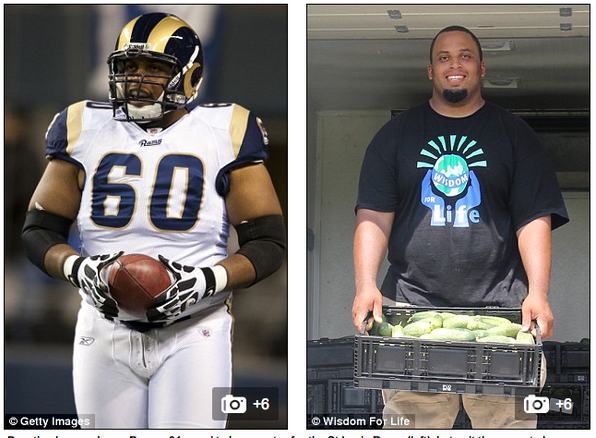
Athlete leaves NFL and $37 million contract to become farmer in order to feed the hungry


PictureJason Brown then and now.
by 
Walter Einenkel


St. Louis Rams center Jason Brown has left the NFL to pursue farming:

“My agent told me, ‘You’re making the biggest mistake of your life,’” Brown told CBS. “And I looked right back at him and I said, ‘No I’m not. No I’m not.’”


Back in 2009, Brown signed a $37.5 million dollar contract with the Rams, making him the highest paid center in all of football. He earned about $25 million of that contract and decided to leave the final year's $12.5 million on the table. Instead, he bought 1,000 acres of farmland in North Carolina.

Brown is doing this to help the less fortunate. He grows sweet potatoes and other vegetables and donates his harvest to food pantries. According to the New & Observer, he has given away 46,000 pounds of sweet potatoes and 10,000 pounds of cucumbers this fall.Keep in mind the fact that Brown left the NFL at 29. He was going to get another pretty large contract to play for a few more years. Instead, in 2012 Brown began watching YouTube videos about farming in order to learn how to farm.He calls his farm the "First Fruits Farm." And it's not only fruits and vegetables--congratulations are in order:

Jason Brown, the former NFL star who retired from football so he could grow crops to feed the hungry, delivered his own child Tuesday at his Louisburg home.Brown and his wife, Tay, had planned to have help for the home birth, but the mother went through labor so quickly that Lunsford Bernard Brown III made his debut before the reinforcements could arrive.

Everything I've read about him so far is pretty great. So this holiday season, raise a glass to Jason Brown and the many other kind souls who put people ahead of themselves.

2014 was a big year for people standing up to injustice


Picture
By Heather Smith

Last year at this time I sat in a hotel lobby, surrounded by multigenerational families digging into buffet dinners, and typed up my predictions for how the rabblerousers of the environmental movement would fare in 2014.

What did the future hold? Would Republicans win control of the Senate, as they were so ardently planning to? Would the activism that was migrating away from one big fight (Keystone XL) dwindle once it dispersed out to smaller, more regional battles over fossil fuel infrastructure like coal terminals? Would it ever rain in California again?

Here are some things I was not expecting: the way that Twitter — despite the fact that it is now a full-fledged business beholden to its shareholders and the work of pulling in advertising dollars — would play an even bigger role in activist organizing. Certain messages — #yesallwomen, #blacklivesmatter, #alivewhileblack, #iftheygunnedmedown — took issues that the media initially passed over and kept them in the spotlight.

I was not expecting a 300,000-plus person march in New York City, and I did not expect to see coalition-building (or at least the early stages of it) between environmental groups and civil rights groups. I was pleasantly surprised to find that, when Naomi Klein’s new book came out, she did not face a chorus shouting “Commie!” just for saying that capitalism isn’t working out super well for everyone at the moment.

Here’s how it all unfolded, in a month-by-month breakdown.

January

The pipeline formerly known as KXL South and now known as the less controversial “Gulf Coast Pipeline” formally opens on Jan. 22, at 10:45 a.m., and begins pumping crude from Cushing, Okla., to refineries in Texas. For those opposed to KXL, this is a huge bummer: Because the pipeline doesn’t cross an international border, it doesn’t need presidential approval — but somehow, Obama felt like approving it, anyway.

With the pipeline built, the only thing to do is to organize a pipeline watch in order to keep an eye out for leaks along the route. “We know the reality,” says Kathy DaSilva of Nacogdoches, Texas. “If we are not out watching, we are going to have a contaminated aquifer. We’re going to have to police this ourselves and document it ourselves.”

Also in January: the Final Supplemental Environmental Impact Statement for the rest of Keystone XL is finally released — late on a Friday, right before the Super Bowl. The report concludes that KXL won’t make a difference to the climate or the environment — not because getting tar-sands crude out of the ground and refining it is great for the atmosphere (it isn’t), but because there is so much money to be made from this resource that people will extract and sell it to someone, even if they have to charter a damn limo to drive it across the Canadian border.

February

Another draft of the environmental chapter of the Trans-Pacific Partnership (TPP) trade agreement is leaked. It does not look good. But also, the TPP — which would create trade alliances that could be used to weaken environmental regulations within its many, many member countries — appears to be fractious, and no closer to actual completion.

In Nebraska, a district court rules in favor of Randy Thompson and two other people whose property had been threatened by KXL — specifically, by LB1161, which gave TransCanada eminent domain to build across their property. To KXL’s opponents, this is an unexpected cupcake from the sky: for complex reasons, the ruling effectively resets the clock on the pipeline’s approval process.

March


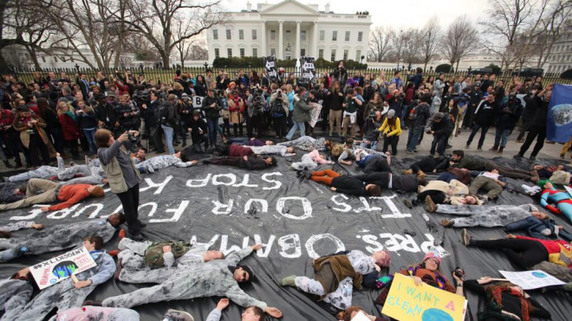
398 college students from across the country stage a die-in on a fake oil spill and lock themselves to the White House fence, then proceed to wait for six hours, in the rain, to be arrested. The protest itself, scrupulously organized by the group XL Dissent, is very much a creation of the Homeland Security era. It is carefully coordinated with Washington, D.C., police, which gave the students a discounted fine ($50 per protestor instead of the usual $100) but also demanded that they use zip-ties to lock themselves to the White House fence if they didn’t want to be charged with a felony.

In Canada, Enbridge wins government approval for its plans for Line 9B, a 38-year-old pipeline that Enbridge plans to expand and reverse the flow of. Like the ongoing boom in oil-by-rail, Line 9B is a sign of the times. As new pipelines (like KXL) hang in limbo, oil and gas companies skirt environmental review and public scrutiny by expanding old networks and pumping crude through existing pipelines.

Meanwhile, Carson City becomes the first California municipality to ban oil drilling — at least temporarily. The 25th anniversary of the Exxon Valdez oil spill rolls around, bringing with it uncomfortable realizations that it is really time to start considering tar-sands crude as “oil” in the eyes of the law and taxing it accordingly, if we want to have any money in the Oil Spill Liability Trust Fund.

April

A group called the Cowboy & Indian Alliance travels all the way to Washington, D.C., from pipeline country and occupies the National Mall for a week. Right before they arrive, Obama again delays making a decision on Keystone.

May

Detroit — which is in the middle of bankruptcy proceedings, as well as an unevenly distributed urban renaissance driven by a single billionaire — begins shutting off water to customers who are behind paying their water bills. A grassroots resistance against the shutoffs begins to develop, composed of residents who argue that water is a human right and that an income-based payment plan should be available to the city’s residents, nearly half of whom live below the federal poverty line.

June

Climate change unexpectedly becomes the big hot issue in several upcoming Senate races, particularly the one between Rep. Gary Peters (D-Mich.) and the Republican candidate, former Michigan Secretary of State Terri Lynn Land. This is almost entirely due to a $100 million midterm attack on climate change deniers in Colorado, Florida, Iowa, Michigan, Maine, New Hampshire, and Pennsylvania, organized by Tom Steyer’s NextGen climate super PAC, which is itself responding to the Koch brothers’ super PAC, Americans for Prosperity.

The Obama administration releases its new EPA rules. The federal Department of Transportation grants oil-by-rail activists something they’ve long agitated for, and issues an emergency order requiring that railroads tell state emergency responders when and where they are routing trains full of highly explosive Bakken crude. The railroads promptly turn around and try to force state emergency responders to sign non-disclosure agreements promising not to share the information with anyone else. The federal government responds by declaring that public release of details about oil-train routes and shipments do not pose a serious security risk.

Canadian Prime Minister Stephen Harper approves the Northern Gateway pipeline. If Keystone XL was Plan A, Northern Gateway is Canada’s Plan B for getting tar-sands crude to market.

The Wet’suwet’en — one of the First Nations opposed to Northern Gateway — have already built and occupied blockades along the proposed route. “We’ll just say ‘you don’t have jurisdiction,’” Freda Huson, one of the nation’s leaders, tells the Globe and Mail.

Later in June, the Supreme Court of Canada resolves a three-decades old case raised by First Nations groups in British Columbia about logging in their traditional hunting grounds. The decision gives First Nations not only control over the land that they live on, but the land where they hunt and fish — bad news for the Northern Gateway pipeline.

Meanwhile, the environmentally inclined billionaire boys’ club of Tom Steyer, Michael Bloomberg, and Henry Paulson releases the “Risky Business” report, which states that not fighting climate change will take out between $66 billion and $106 billion of coastal property in the U.S. alone.

A federal judge blocks a coal mine expansion on public land in Colorado for what could be a precedent-setting reason: failing to consider how that expansion could exacerbate climate change. On June 29, TransCanada’s permit to build the Keystone XL pipeline across South Dakota quietly expires, making KXL look less and less like a done deal.

 July

The Iowa Supreme Court rules that utilities don’t have a leg to stand on when they complain that solar panel startups are muscling them out of their exclusive rights to sell electricity in an area. This ruling is just one of many battles playing out across the country at the state and local level. Washington state manages to lop $2,500 off the cost of solar panels by streamlining the installation-approval process, while other states like Florida and Wisconsin go in the opposite direction, making solar more expensive and harder to obtain.

After protesters block utility shut-off trucks and hold a giant march featuring Mark Ruffalo, Detroit Water and Sewerage District (DWSD) announces that it will stop shutting off people’s water, at least for now. Another coal export terminal planned for the West Coast bites the dust.

August

A police officer shoots and kills Michael Brown, an unarmed 18-year-old, in Ferguson, Mo. Not, in itself, an unusual occurrence, sadly. Still, something about Brown’s death really gets to people, especially after Ferguson police respond to a candlelight vigil by dragging out an eye-popping quantity of decommissioned military gear and proceeding to arrest reporters, tear-gas peaceful protesters, and act like they are putting on a summer stock theater production of Full Metal Jacket. Activist networks that have been developing since the shooting of Trayvon Martin, another unarmed teenager, two years earlier, begin to converge on Ferguson.

The state of Oregon rules against another coal terminal proposed for the Port of Morrow, and in Washington, the Lummi people launch a protest that plans to bring together indigenous tribes from the Midwest to the Pacific Northwest for a unified front against Big Coal and Big Oil.

On the East Coast, the Tennessee Gas Pipeline Northeast Expansion Project, which Kinder Morgan was planning on running between Boston and New York State, is put on hold, perhaps permanently, after activists argue that the east cost needs to focus more on renewable energy options. “Before we sink more money in gas infrastructure,” Sen. Elizabeth Warren (D-Mass.) writes in an editorial in the Berkshire Eagle, “we have an obligation wherever possible to focus our investments on the clean technologies of the future — not the dirty fuels of the past.”

September

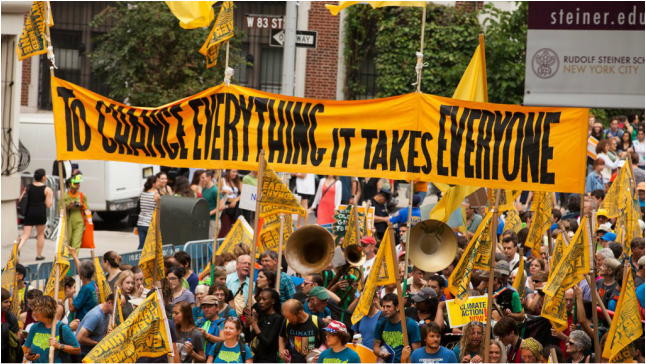
The People’s Climate March – months in the making – surges through New York City, right before the United Nations Climate Summit. It’s meant to be the most inclusive climate march ever. Some say a little too inclusive: Groups like the International Brotherhood of Electrical Workers are fighting the EPA’s power plant regulations at the same time that they are participating in the march.

People converge on New York from all over the U.S. The march appears to be everything it was intended to be: massive (more than 300,000 people turn out), peaceful, and inclusive. It appears to have very little effect on the U.N. Climate Summit — but then, not many people were really expecting it to. The next day, a smaller protest, Flood Wall Street, blocks off Broadway for several hours and results in the arrest of 102 people, including two Captains Planet and one polar bear.

The new report from the United Nations’ Intergovernmental Panel on Climate Change is released, and the Peoples’ Climate March organizers announce their support for Ferguson October, a conference in Ferguson for groups interested in protesting the militarization of police departments.

October

In Detroit, the judge in charge of Detroit’s bankruptcy, Steven Rhodes, rules that water may be “a necessary ingredient to sustaining life,” but there is no “enforceable right to free and affordable water.” A few weeks later, Catarina de Albuquerque, the U.N. special rapporteur on the human right to safe drinking water and sanitation, visits Detroit and disagrees — the city’s water shutoffs, she says, amount to a violation of basic human rights.

November

Oh, the elections. The midterm elections do not go well for environmental activists. On the local level, there are a few victories, like tiny Richmond, Calif., where Chevron spent $72 per voter to elect a more Chevron-friendly slate of candidates, and lost, big time.

Still, immediately after the elections, some unexpected good climate news: President Obama and Chinese President Xi Jinping, the heads of state for the two biggest greenhouse-gas emitters in the world, are together pursuing ambitious new emission reductions.

The lame duck Senate votes not to approve Keystone. In the chambers, Greg Grey Cloud, a Native American activist, bursts into a song of thanks and is promptly kicked out of the chamber.

In Missouri, a grand jury decides not to indict the police officer who shot Michael Brown. Protests break out across the country in Atlanta, Boston, Chicago, Los Angeles, Oakland, San Francisco, Minneapolis, New York, and Washington, D.C., all of them working from common themes — staging die-ins in public spaces, blocking highways and other main transportation routes, and targeting areas associated with holiday shopping. At this point, it becomes manifestly clear that a lot of organizing went down during Ferguson October, and that America has a burgeoning civil rights movement on its hands.

December

In New York, another grand jury decides not to indict a police officer who choked Eric Garner, a Staten Island resident, to death. Protests, again, break out across the country, and many environmentalists — including the director of the Sierra Club — declare their support.

The actual details of the Trans-Pacific Trade Partnership remain mysterious, but that doesn’t stop a smorgasbord of rabblerousers from fretting about it. Digital privacy activists worry it will be used to enable surveillance. Elizabeth Warren worries it will be used to gut financial regulations. Opponents fear that with the Senate now controlled by Republicans, TPP is more likely to win approval.

All year, the price of oil has been falling, and by now a barrel costs just a little more than half its most recent peak. Oil is trading at its lowest since the recession of 2009, prompting allegations that OPEC (in particular, Saudi Arabia) is putting the screws to Iran, Russia, and the U.S. shale oil boom in one fell swoop.

It is at this moment, while fracking operators in the U.S. find themselves in a financial squeeze, that New York Gov. Andrew Cuomo announces that he will ban fracking in New York entirely.

New York isn’t the first state to ban fracking; that would be Vermont. But it’s the site of much more valuable land, fracking-wise. The ban vindicates the work of anti-fracking activists across the state, who spent years working together to use zoning to not-quite-ban fracking piece by piece, at the local level.

At a press conference, Barack Obama essentially makes fun of Keystone XL in a way that made the pipeline’s eventual approval seem highly unlikely. “Keystone is not American oil,” Obama says. “It’s Canadian oil that is wrung out of tar sands in Canada. It would save the Canadian oil companies and the Canadian oil industry an enormous amount of money if they could simply pipe it all the way through the United States down to the Gulf.”

“It’s not,” he continues, “going to be a huge benefit to U.S. consumers. It’s not even going to be a nominal benefit for U.S. consumers.”

What does 2015 hold? I have a mantra for situations like these, courtesy of one of the better philosophers of our time: “The future is unwritten.” That’s not going to stop me from trying to predict it, though. Stay tuned.

More Information:
...........................
Content from Grist
Posted January 2015
Grand Jury Indicts Indiana Couple in Starvation Death of Infant in Lakeland


Roy Stephens, 48, left, and Ruby Stephens, 23.


BARTOW | A grand jury indicted a couple Thursday in the starvation death of a 22-day-old baby in their custody just days before Christmas.
Roy and Ruby Stephens, 48 and 23, respectively, are both facing charges of first-degree murder, aggravated child abuse and aggravated manslaughter of a child in the death of Betsy Kee Stephens on Dec. 23.
Associate Medical Examiner Dr. Vera Volnikh said Betsey died from "starvation due to neglect," and her manner of death was "homicide," reports state.
The family took a trip from Tennyson, Ind., to visit family in the Lakeland area and arrived Dec. 23, reports state.
The family went to Golden Corral on U.S. 98 North, and Ruby Stephens pulled Betsy out of the car to find she was cold to the touch and un­responsive.
Ruby Stephens told detectives she had fed Betsy an hour before she found her unresponsive, but the medical examiner said the child had not eaten for several hours before she died, reports state.
Betsy weighed 4 pounds and 1 ounce when she died, the report said, which is about half the normal weight for a child her age.
Roy Stephens is not the biological father, but together the couple has a 1-year-old boy and a 2-year-old girl who have been in the custody of the Florida Department of Children and Families.

 http://www.theledger.com/article/20150116/NEWS/150119537/-1/news300?Title=Grand-Jury-Indicts-Indiana-Couple-in-Starvation-Death-of-Infant-in-Lakeland

Russia, China and Uncle Sam: Who's in bed with Whom?

Watching the positioning of the BRICs nations over the past two months has been VERY interesting.  Watching the positioning of Russia gathering up allies  and China buying up allies has also been very interesting to observe.

China has been making moves into Africa for a long time, but their recent moves into South America and the Caribbean arena has been very telling of a super power making it's moves to consolidate it's reach.


Russia on the other hand is also consolidating its power base.  While western media outlets like to portray Russia as the evil bad guy who's currency is crashing and economy is falling to pieces.... they do not like to actually shine any light on the very fact that Russia IS gathering a strong group of supporters, and their economy is no worse off than the US, England and the European Union. In fact, in actuality Russia is much stronger than the entire group.  One of the reasons is the resilience of the Russian people and it's government to keep focused on internal issues- such as creating their OWN power, growing their OWN food- so that external pressures, like international sanctions and the collapse of the oil/OPEC market, are not as damaging to their internal structure as it would be to nations, like the US and UK, who live WAY beyond their means and have lost the ability to even feed themselves without needing to import external sources  to spoon feed them processed foods laden with chemicals and GMO toxins.  ..... But I digress.  That is an article for another day.


While the western media whores are distracting the world with visions of terrorists hiding behind every rock and tree, Russia and China have been quietly insuring that they have the power players already picked out and ready to put on their new jerseys.  The sudden appearance of the Eurasian Economic Union over the holidays and New Years, while penned in May of 2014- without hardly a mention by western media- was a shock to many on January 2nd, 2015- more so when Russian told the European Union nations to come on over to their shiny new Union and leave that defunct busted ass EU behind....


Already France has called for abolishing the sanctions against Russia, and former German political figures jumped on that bandwagon as well. (interesting, eh?),  and a lot of nations are real cozy with Russia already, and not just the "baddies" like Syria and Iran as the western press would have you believe.


russian and pakistan
http://itar-tass.com/en/economy/771403
russian and venezuela
http://itar-tass.com/en/world/771406
russian and brazil
http://itar-tass.com/en/economy/767632
russia and monaco
http://itar-tass.com/en/world/771379


China and Russia's alliances are well touted through the main stream media- seeing as they are both "the bad guy" so it's safe to draw those connecting lines publicly.  And the public knows about the BRICs nations- or at least they should by now- if they don't, perhaps we should just pull the plug now and stop those human sponges from wasting everyone else's air. (sorry, but the abject ignorance of the masses in certain places *cough cough cough *US* cough cough cough* makes me want to rip my hair out).


But what is the real truth? First the BRICs are back in the media spotlight again- or at least, in the Russian media:
 http://itar-tass.com/en/economy/770911