Monday, March 23, 2015

Odin Camus: Boy With Asperger’s Sent Out Birthday Invite And No One Replied — Then This Happened


Posted in: Human Interest

Odin Camus: Boy With Asperger’s Sent Out Birthday Invite And No One Replied — Then This Happened


Odin Camus Asperger's birtthday
Odin Camus is a boy from Peterborough, Ontario, who happens to have Aspergers syndrome and who celebrated his 13th birthday on Friday. But according to his mom, “due to his Aspergers, Odin has some difficulty making friends.” He also often finds himself the victim of school bullies, who, rather than understand his condition, choose to be cruel instead.
So when Odin sent an invitation to his bowling alley birthday party out to 15 people — not a single one got back to him.
If that had been the end of the story, this would have been a sad one indeed. But fortunately for Odin, his mother, Melissa Camus, made sure that the last chapter was far from written.
The first thing she did was
create an “event” on Facebook, asking very sweetly if some fellow moms would help Odin “feel loved.”
Did the moms respond? To say they did would be the understatement of the century.
The invite to Odin’s birthday party quickly went viral, and when Odin showed up at his local bowling alley for what he thought would be a low key birthday “hang out,”
hundreds of people, most of them complete strangers who wanted nothing but to make a kid feel good on his birthday, were there waiting for him.
Not only that, someone chartered Odin a limo, giving him the full star treatment.
“Wow, it’s amazing to know how much people care,” Odin declared as he arrived to cheers and applause outside Lakeview Bowl on March 20. “It makes me feel amazing. I got a taste of what celebrities feel like.”
But if you think the jam-packed birthday party is the Odin Camus story’s happy ending — you’re wrong again. There’s more. The birthday invite went worldwide, and Odin reportedly received more than 11,000 messages on Twitter wishing him a happy birthday.
Not only that, someone chartered Odin a limo, giving him the full star treatment.
“Wow, it’s amazing to know how much people care,” Odin declared as he arrived to cheers and applause outside Lakeview Bowl on March 20. “It makes me feel amazing. I got a taste of what celebrities feel like.”
But if you think the jam-packed birthday party is the Odin Camus story’s happy ending — you’re wrong again. There’s more. The birthday invite went worldwide, and Odin reportedly received more than 11,000 messages on Twitter wishing him a happy birthday.
The messages came from every corner of the globe.
Celebrities and politicians even got in on the uplifting act. Elijah Wood, best known as “Frodo” from the Lord of the Rings movie trilogy, sent a tweet, as did Justin Trudeau, member of parliament and leader of Canada’s Liberal Party.

Not only that, someone chartered Odin a limo, giving him the full star treatment.
“Wow, it’s amazing to know how much people care,” Odin declared as he arrived to cheers and applause outside Lakeview Bowl on March 20. “It makes me feel amazing. I got a taste of what celebrities feel like.”
But if you think the jam-packed birthday party is the Odin Camus story’s happy ending — you’re wrong again. There’s more. The birthday invite went worldwide, and Odin reportedly received more than 11,000 messages on Twitter wishing him a happy birthday.
The messages came from every corner of the globe.
Celebrities and politicians even got in on the uplifting act. Elijah Wood, best known as “Frodo” from the Lord of the Rings movie trilogy, sent a tweet, as did Justin Trudeau, member of parliament and leader of Canada’s Liberal Party.
Then there was this one, from Josh Donaldson and Aaron Sanchez, players for Canada’s only big league baseball team, the Toronto Blue Jays.






Odin and I have been pretty much crying all day,” his mom, Melissa, told the Toronto Sun, as a limo carrying Odin Camus dropped the teenager off. “People are here because everyone knows a kid who struggles to fit in. You don’t have to be bummed out — no matter how down you feel, there’s always someone there. Always.”


Ted Cruz Website Says Support Barack Obama And Immigration Reform?

Ted Cruz Website Says Support Barack Obama And Immigration Reform?


Ted Cruz Barack Obama
Just one day before Ted Cruz is rumored to be announcing his official candidacy for the 2016 Republican nomination, the conservative figure has been hit by one of his first jabs in the battle for the White House — one that has him pledging support for the current occupant Barack Obama.
Seeing that the domain TedCruz.com was up for grabs, some pranksters took advantage of the situation and posted a very un-Ted like message that will instead find users looking for Cruz’s official page. That message called for support for all the things that Ted has built his career taking a stand against.

Read more at http://www.inquisitr.com/1947748/ted-cruz-website-says-support-barack-obama-and-immigration-reform/#s3C4wJ0UzY60htAW.99

Amid Fear of Russian Invasion, Baltic Countries Welcome US Support


Amid Fear of Russian Invasion, Baltic Countries Welcome US Support


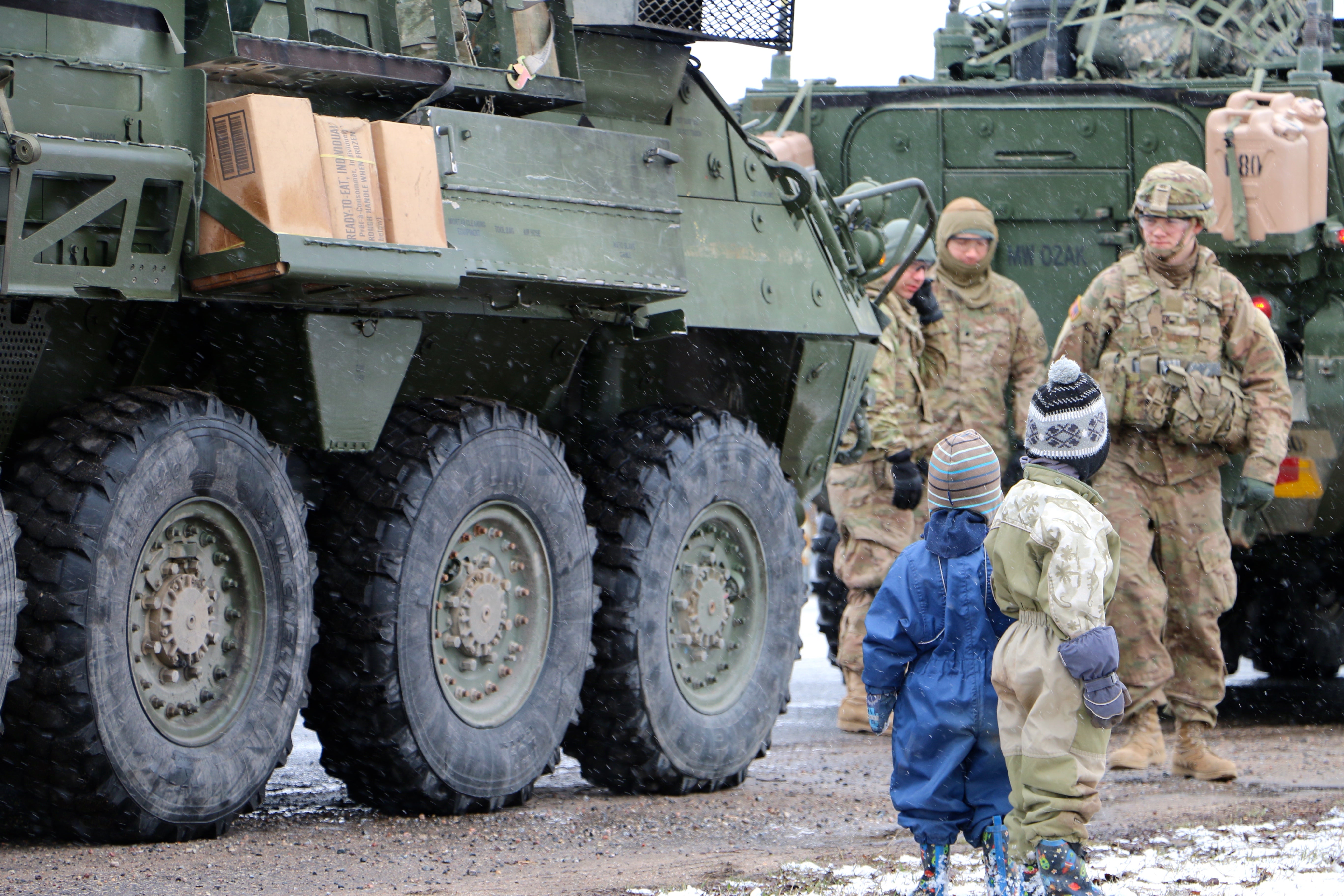
The U.S. Army Stryker convoy makes a stop in Latvia, March 22. (Photo: Nolan Peterson/The Daily Signal)
MARIJAMPOLE, Lithuania—Citizens of the three Baltic countries have showed up in droves to welcome a U.S. Army Stryker convoy, which is traveling across Eastern Europe to underscore NATO’s commitment to defend the region from Russia.
Soldiers from Iron Troop, 3rd Squadron, 2nd Cavalry Regiment arrived here Monday after a three-day journey that began Saturday in Tapa, Estonia and passed through Latvia. Along the way citizens lined the roads to take pictures. Some held American flags. Others had young children in their arms, who waved at the passing U.S. military vehicles.
“It’s a great experience, it’s very humbling,” said Army Sgt. Greg Odom, part of Iron Troop. “Waving at them, them waving back, smiling. You can tell you’re bringing joy to them.” The unexpectedly large turnout along Iron Troop’s route underscores a pervasive regional anxiety about the Ukraine conflict, which many fear is a bellwether for future Russian aggression in the Baltics.
“I think everyone in Latvia who values freedom is concerned about what’s going on in Ukraine,” said Viktor, a 57-year-old father of three who took his family to see the convoy at a stop on the outskirts of the Latvian capital of Riga on Sunday.
Viktor, who held an American flag in his hand as he talked, said NATO should build a permanent base in one of the three Baltic countries to deter Russia.
Viktor, 57, poses with a U.S. soldier at a stop in Latvia, March 22. (Photo: Nolan Peterson/The Daily Signal)
He also pressed the U.S. to arm Ukraine, adding: “What’s the alternative? If the bad guy wants to go into your house, do you let him into your house or go out and buy a stronger lock? I consider not arming Ukraine a big mistake.”
For 90 days, 3/2 soldiers have been deployed to Estonia, Latvia, Lithuania and Poland supporting Operation Atlantic Resolve, a series of U.S. exercises in Eastern Europe meant to “reassure NATO allies and partners of America’s dedication to enduring peace and stability in the region, in light of the Russian intervention in Ukraine,” according to a Department of Defense statement.
The convoy, called Operation Dragoon Ride, is the capstone to 3/2’s Baltic deployment. The unit’s personnel and their Stryker armored fighting vehicles, along with a host of support vehicles and local police escorts, are traveling 1,100 miles by road from Estonia to Vilseck, Germany.
Iron Troop’s 150 soldiers—who only two decades ago would have been considered enemies of the Soviet army controlling the region—weren’t sure how civilians would receive them, or if the convoy would receive much attention. But they have experienced a remarkably enthusiastic response, which reminded some soldiers of scenes of the U.S. Army liberating countries in World War II.
“It reminds me of a scene from ‘Band of Brothers’ or ‘Saving Private Ryan,’” said Army Lt. Dan Keogh of Iron Troop.
“You see them along the road, waving at you. They come up and want to shake your hand,” he added. “I’d say 90 to 95 percent of the people are very glad we’re here and wishing we’d stick around. It makes them feel very secure that we’re in the area.”
The convoy ended its first day in Parnu, Estonia Saturday, where a local military brass band braved the subzero temperatures to play American tunes, including “Hail to the Chief.” Crowds weaved through the parked Strykers and Humvees on static display, on which children climbed like jungle gyms.
Estonian children observe U.S. soldiers at a road stop on Operation Dragoon Ride on March 21. (Photo: Nolan Peterson/The Daily Signal)
Conversations between soldiers and civilians drifted between recommendations about Estonian beer to what Russian President Vladimir Putin might do next.
“Estonians are worried about a war between Russia and the United States,” said Boris, 37, an Estonian who attended Saturday’s Stryker display in Parnu with his three-year-old son. “We see the news. We see what’s happening in Ukraine. This is a war. This is our reality.”
Dragoon Ride has also highlighted the high regard NATO allies have for the U.S. military.
“If America is here, there will be no problem,” said Estonian Private First Class Richard Kuusk. “The Estonian military is small and not very strong, so it’s important for the U.S. to be here. We see what’s happening in Ukraine, and we don’t want that to happen here.”
Sunday’s journey ended in the Latvian capital of Riga. Despite the cold and wind, anxious crowds gathered and waited to greet the troops at villages along the route. Young children posed with obliging U.S. soldiers as mothers and fathers snapped photos. Lines formed at the back of Strykers with those anxious to look inside or shake a soldier’s hand. At one small village, the local mayor arrived to greet the convoy.
The conversations, again, centered on the Russian threat.
“I hope that nothing like what happened in Ukraine or Crimea will happen here,” said Leonard, 26, a Latvian agriculture worker who attended one of Monday’s static displays. “Here there are many people who think the Russian boys will be a little bit angry about the Americans being here. But I think it’s good they are here. It makes me feel a little bit safer.”
On Monday, Iron Troop entered Lithuania. Officials at the border distributed Lithuanian and U.S. flags to be tied on the radio antennas of the armored fighting vehicles. A short time later, the convoy entered the border town of Salociai, where, once dismounted, the Americans were asked to pose with Lithuanian soldiers while holding machine guns and flexing their biceps. Lithuanian students posed with a banner that read, “Together we can save our freedom.”
A woman at a static display in Turi, Estonia for Operation Dragoon Ride on March 21. (Photo: Nolan Peterson/The Daily Signal)
A speaker, whose words were relayed through an interpreter, spoke about the two countries’ shared values and ability to “overcome any common enemy.”
“We’ve had freedom for more than two decades,” the speaker said, “and we’re willing to fight to keep it.”
As the convoy pulled out of town, women ran up and handed flowers to soldiers standing in gun turrets.
“The reaction has been overwhelmingly positive,” said Army Sgt. Garrick Jones, who has deployed to both Iraq and Afghanistan. “It was a lot more than I expected. It obviously means a lot to these people that we’re here. And I’m proud about that.”
This is the first deployment for some of Iron Troop’s younger soldiers. During down time, the more experienced troops shared stories with the younger ones about combat in Afghanistan and Iraq, recounting battles with the Taliban and al-Qaida, the focal enemies of U.S. armed forces for more than a decade.
But the olive green paint scheme on the Strykers, the cold Baltic forests, the thankful crowds on the road, the faces curiously poking out from behind lace curtains and the prolific relics of the Soviet Union portend a different type of war than most current U.S. soldiers expected to fight.
“When I was in ROTC we trained for mountain warfare,” Lt. Keogh said. “But things have changed. Now we’re talking about threats we haven’t had to seriously consider dealing with for decades.”
On Tuesday, the convoy will travel from Marijampole to Suwalki, Poland, passing within about 12 miles of the western Russian territory of Kaliningrad.
Iron Troop departs Tapa, Estonia on March 21. (Photo: Nolan Peterson/The Daily Signal)
Last week, Russia announced the deployment of Iskander missiles to Kalinigrad as part of snap military exercises. Iskander missiles are designed to carry both nuclear and conventional warheads and have a range of about 300 miles, which means the missiles in Kaliningrad could strike Poland, Latvia, Lithuania and Estonia.
“We have to face reality,” Viktor said as he waved his U.S. flag and gave a thumbs up to a passing Stryker. “We’re only kidding ourselves and burying our heads in the sand if we think the Russian problem will solve itself.”

Things Are Unraveling At An Accelerating Rate

Those who brought their consumption forward can no longer add to present consumption
european-stocks
by Charles Hugh Smith | Peak Prosperity

Does anyone else have the feeling that things are not just unraveling, but that the unraveling is gathering speed?

Though quantifying this perception is more interpretative than statistical, I think we can look at the ongoing debt crisis in Greece as an example of this acceleration of events.

The Greek debt crisis began in 2011 and reached a peak in 2012. The crisis was quelled by new Eurozone/IMF loans to Greece, and European Central Bank chief Mario Draghi’s famous “whatever it takes speech” in late July, 2012.

The Greek debt crisis quickly went from “boil” to “simmer,” where it stayed for almost two-and-a-half years. But no one with any knowledge of the gravity and precariousness of the situation expects the latest “extend and pretend” deal to patch everything together for another two years.  Current deals are more likely to last a matter of months, not years.

We can discern the same diminishing returns in Federal Reserve/central bank interventions, as the initial rounds of quantitative easing pushed stock and bond markets higher for years at a time, while the following interventions generated lower returns.

What factors are reducing the positive effects of intervention and causing increased volatility? Let’s start with the engine behind every central bank/state intervention and every “save” of the status quo: debt.

Debt Brings Forward Consumption & Income

Debt has one primary dynamic: borrowing money to consume something in the present brings forward consumption and income.  Economists describe trading future income for consumption today as bringing consumption forward. And since debt must be repaid with interest, bringing consumption forward also brings income forward.

Let’s say we want to buy a vehicle with cash, and it will take five years to save up the lump-sum purchase cost.  We forego current consumption to save for future consumption.

If we get a 100% auto loan now, we get the use of the vehicle (present-day consumption) and in exchange, we sacrifice some of our income over the next five years to pay back the auto loan. We brought consumption forward, and in essence took future income and brought it forward to pay for the consumption we’re enjoying today.

We can best understand the eventual consequence of this dynamic with a simplified household example. Let’s say a household has $2,000 a month in net income, i.e. after taxes, healthcare insurance deductions, etc., and rent (or mortgage payments), basic groceries and utilities consume $1,000 of this net income. That leaves the household with $1,000 in disposable income.

At the risk of boring finance-savvy readers, let’s briefly cover the difference between net income and disposable income. Net income can be earned (wages, salaries, net income from a sole proprietor enterprise, etc.) or unearned (dividends, interest income, rents, etc.) Net income can only rise by making more money or reducing taxes. There are limits to our control of these factors. In a stagnant economy, it’s tough to find better-paying jobs and harder to demand higher wages from employers.  Since governments’ expenditures are rising, taxes are also going up; it’s difficult for most wage-earners to cut their total tax load by much.

Disposable income is more within our control, as it is fundamentally a series of trade-offs between current consumption and future income/savings: if we choose to consume now, we have less income to save for future consumption or investments.  If we sacrifice consumption today, we have more money in the future for consumption or investing. If we borrow money to consume today, we’ll have less future income because a slice of our future income must be devoted to pay down the debt we took on to consume today.

If our household borrows money to buy a vehicle and the payment is $500 per month, the household’s disposable income drops from $1,000 to $500. If the household takes on other debt (credit cards, student loans, etc.) with payments of $500 per month, the household’s disposable income is zero: there is no money left to dine out, go to movies, pay for lessons, etc.

In effect, all of the future income for years to come has been spent.

The Only Trick To Expand Debt: Lower Interest Rates

There are only two ways to support additional debt: either increase net income, or lower the rate of interest on new and existing loans to free up disposable income.  Suppose our household refinances its auto loan to a much lower rate of interest and transfers its credit card debt to a lower-interest rate card.  Huzzah, each monthly payment drops by $100, and the household has $200 of disposable income to spend on current consumption or on more loans. Let’s say the household chooses to buy new furniture on credit with the windfall. This new consumption brought forward pushes the monthly debt payments back up to $1,000.

This additional debt-based consumption profits two critical players in the economy: the state (i.e. all levels of government) and the financial sector. The state benefits from the higher taxes generated by the sales, and the financial sector profits from transaction fees and the interest earned on the new loans.

The household’s consumption and debt rose as a result of lower interest rates, but there is a limit on this dynamic: lenders have to charge enough interest to service the loan, reap a profit and compensate shareholders for the risk of default.

If lenders fail to properly assess the risk of default. They will be unprepared to absorb the losses incurred as marginal borrowers default en masse. This places the lender’s own solvency at risk.

Using this trick to enable further expansion of debt thus creates a systemic risk that borrowers will over-borrow and lenders will not have sufficient reserves to absorb the inevitable losses as marginal borrowers default and other borrowers suffer declines in disposable income that trigger further defaults.

In other words, the trick of lowering interest rates yields diminishing returns: the more debt that is enabled,  the thinner the margins of safety and thus the greater the systemic risks rise in direct correlation with rising debt loads.

The Trick To Increase Consumption: Punish Savers

While lowering interest rates increases disposable income and enables an expansion of debt, it also generates a disincentive for households to forego current consumption by saving disposable income rather than spending it.  Near-zero interest rates actively punish savers by reducing the interest income earned on low-risk savings accounts and certificates of deposit (CDs) to near-zero. Savers are pushed into either investing in high-risk markets that benefit the financial sector or by spending rather than saving—a choice that benefits the state, as more spending generates taxes for the state.

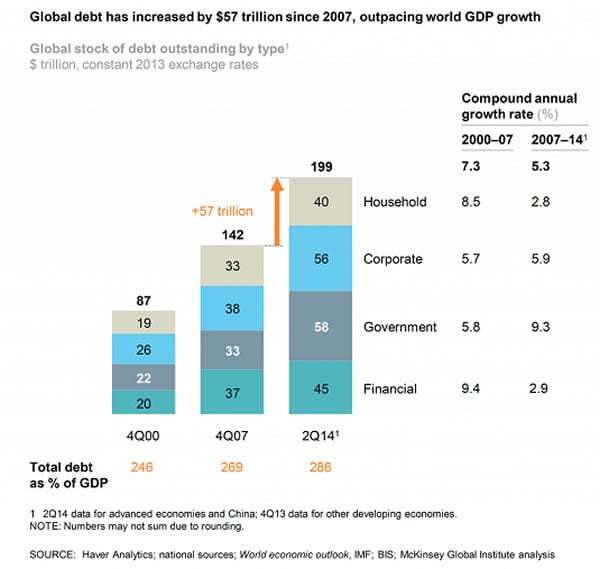
The Global Expansion Of Debt Has Increased Systemic Risks

These are the basic dynamics of the entire global economy: interest rates have been pushed to near-zero to punish savers and encourage expansion of debt-based consumption. But this inevitably leads to a reduction in disposable income and current consumption, as debt brings forward both consumption and income.

Once the borrowers have maxed out their borrowing power, there is no more expansion of debt or additional debt-based consumption.  This is known as debt saturation: flooding the financial sector with more credit no longer boosts borrowing or brings consumption forward.

Those who brought their consumption forward can no longer add to present consumption, as their future income is already spoken for.

That’s where the global economy finds itself today.


This vast expansion of debt on the backs of marginal borrowers and the expansion of risky investments has greatly increased the systemic risk of losses from defaults arising from over-extended borrowers.

No wonder every attempt to further expand debt-based consumption is yielding diminishing returns: net income is stagnant virtually everywhere in the bottom 95% of the populace, and further declines in interest rates are increasingly marginal as rates are near-zero everywhere that isn’t suffering a collapse in its currency.

The diminishing returns manifest in three ways: the gains from each round of central-bank tricks are declining, the periods of stability following the latest “save” are shrinking and the amplitude of each episode of debt crisis is expanding.

That things are speeding up is not just perception—it’s reality.

In Part 2: The Coming Age Of Confiscation, we’ll look at the threat of the other fundamental driver of rising instability: the broken-logic TINA (there is no alternative) mind trap our global leaders are mired in. As the trajectory of the status quo worsens for all the reasons discussed above, government will become increasingly heavy-handed in appropriating the remaining wealth in order to keep things stumbling on just a little bit longer — justifying its actions by claiming it “has no other choice”.

Ukraine oligarchs ‘top cash contributors’ to Clinton Foundation prior to Kiev crisis


From 2009 up to 2013, the year the Ukrainian crisis erupted, the Clinton Foundation received at least $8.6 million from the Victor Pinchuk Foundation, which is headquartered in the Ukrainian capital of Kiev, a new report claims.
In 2008, Viktor Pinchuk, who made a fortune in the pipe-building business, pledged a five-year, $29-million commitment to the Clinton Global Initiative, a program that works to train future Ukrainian leaders “to modernize Ukraine.” The Wall Street Journal revealed the donations the fund received from foreigners abroad between 2009-2014 in their report published earlier this week .
READ MORE: Dutch dismiss reports alleging MH17 downed by Buk missile
Several alumni of the program have already graduated into the ranks of Ukraine’s parliament, while a former Clinton pollster went to work as a lobbyist for Pinchuk at the same time Clinton was working in government.
Between 2009 and 2013, the very period when Hillary Clinton was serving as US secretary of state, the Clinton Foundation appears to have received at least $8.6 million from the Victor Pinchuk Foundation.
That places Ukraine as the leading contributor among foreign donators to the Clinton Foundation.
Foreign Donors to Clinton Foundation by Ranking
Ukraine: $10.0 million
England: $8.4
Saudi Arabia: $7.3 million
Germany: $6.7 million
Ireland: $6.5 million
India: $5.0 million
Canada: $4.5 million
Argentina: $2.0 million
United Arab Emirates: $1.4 million
China: $1.3million
Source: Wall Street analysis of Clinton Foundation disclosures
The Pinchuk foundation said its donations to the Clinton-family organization were designed to make Ukraine “a successful, free, modern country based on European values.” It went on to remark that if Pinchuk was hoping to lobby the US State Department about Ukraine, “this cannot be seen as anything but a good thing,” WSJ quoted it as saying.
However, critics have pointed to some disturbing aspects regarding the donations, including the coincidence of the Ukrainian crisis, which began in November 2013, and the heavy amount of cash donations being made to the Clinton Foundation on behalf of wealthy Ukrainian businessmen. In any case, given that Hillary Clinton appears to be considering a possible run in the next presidential elections, more scrutiny will be devoted to her past work with the charity that bears the Clinton name.
First, as already mentioned, Clinton was serving as the US secretary of state at the time that the donations to her family’s charity were being made. Although it is true that the Clinton Foundation refused donations directly from foreign governments while Clinton was serving in the Obama administration, the door remained wide open to donations from public citizens like Pinchuk, who has advocated on behalf of stronger ties between Ukraine and the European Union.
Political connections in the Pinchuk family run deep. Not only did Viktor Pinchuk serve two terms as a Ukrainian parliamentarian, but his wife is the daughter of former Ukrainian President Leonid Kuchma. READ MORE

"Colossal Defeat" For Obama As Australia Joins China's Regional Bank


Do you all hear war drums??? Hmmmmmmmmmmmmmm
Susoni
*********************************************
Having attacked its "closest ally" UK for "constant accomodation" with China, we suspect President Obama will be greatly displeased at yet another close-ally's decision to partner up with the Chinese-led Asian Infrastructure Investment Bank (AIIB). As The Australian reports, "make no mistake," the decision by Australia's Abbott government to sign on for negotiations to join China’s regional bank, foreshadowed by Tony Abbott at the weekend, "represents a colossal defeat for the Obama administration’s incompetent, distracted, ham-fisted dip­lomacy in Asia."
As The Australian's Greg Sheridan writes Op-Ed,
The decision by the Abbott government to sign on for negotiations to join China’s regional bank, foreshadowed by Tony Abbott at the weekend, represents another defeat for Barack Obama’s diplomacy in Asia.
The Abbott government is right to make this decision. It had well-founded concerns about the vague and unsatisfactory governance arrangements of the institution when Beijing first invited Canberra to join.
Link:
http://www.zerohedge.com/news/2015-03-16/colossal-defeat-obama-australia-joins-chinas-regional-bank

Sunday, March 22, 2015

DON'T MISS THIS !! IT'S FAR FROM DULL !!


Watch "Obama and Michelle have come out of the CLOSET...…" on YouTube

Middle East and U.S.: An Insider's Treatise: 1953 to Today

Blowback from Conduct of U.S. Politicians
In the Middle East: 1953 to the Present
This material is presented by Captain Rodney Stich, a former Naval Aviator and Patrol Plane Commander (PPC) in World War II), and former international airline captain. He was in the Middle East when the first event by U.S. politicians and the CIA started destabilizing the Middle East.
In the following years he became close friends with CIA personnel that had engaged in other covert activities, starting before the Soviets entered Afghanistan in 1979. These activities further destabilized the Middle East. Other key  insiders helped to reveal other corrupt actions that led to the easily prevent gable al Qaeda successes, and beyond.
The present calamitous events in the Middle East are the end results of 50-plus years of arrogant and corrupt conduct by U.S. politicians and non-elected CIA personnel.

U.S. Overthrow of Iranian Government: 1953
The Start of Destabilizing the Middle East
In 1953, the CIA, under orders of U.S. and British politicians, funded and directed the revolution that overthrew the democratically government headed

Cities Reducing Minimum Standards for Police Recruits

Posted March 22, 2015
Fewer people going into law enforcement
 law-enforcement
Michael Brown. Eric Garner. Tamir Rice. Wenjian Liu. Rafael Ramos.

These are just a few of the lives that have been claimed by officer-civilian shootings over the last three years. What happened during these incidents can be disputed — the fact that they’ve had an enormous impact on this nation cannot.

Though officer attacks and ambushes are rare, the effect of high-profile civilian deaths has drawn attention to the public perception of those working in law enforcement.

Amid all the tension, including an overwhelming amount of anti-police protests, is the desire to work in law enforcement diminishing?

Former Rapid City Police Chief Steve Allender says he believes those who yearn to become police officers cannot be discouraged by the perceived national crisis.

“Police officers serve their communities because of an illogical commitment to public service. If prospective police employees are aimed at a career in policing, the national tension will not dissuade them. For current police officers, the national tension will likely solidify their commitment to the profession,” Allender told CBS St.Louis.

National President of the Fraternal Order of Police Chuck Canterbury takes a different stance. In addition to the general loss of officers considering law enforcement as a career, Canterbury says the pool of applicants has shifted.

“The recent events in many cities protesting law enforcement have also discouraged applicants because they know even if they do the right thing in a split-second decision that the media and others will spend years second-guessing them and many just feel that type of stress is not worth the meager salaries and reduction in benefits,” Canterbury explains. “Many cities are reducing the minimum standards to attract candidates and there is a general lack of applicants who have higher education or experience that is commensurate with the profession.”

A 2014 Reason-Rupe National Survey found that 50 percent of Americans don’t think police are generally held accountable for misconduct. Forty-one percent said they believe cases of misconduct have increased over the last decade.

Even among those experienced with police enforcement, opinions vary on how things have evolved over time. What the majority of those in the field can agree on is that something needs to be done to move forward in an effective and positive way.

Read more

Board of Governors of World Bank and IMF announce transition to asset-backed currencies

Board of Governors of World Bank and IMF announce transition to asset-backed currencies

[PRESSWIRE] Washington DC, United States - 09 March 2015 - The Board of Governors of the World Bank and IMF announced that fractional reserve fiat currencies will be replaced with gold from a trust created at the end of World War II.

Jose Rizal, Superior General of the Society of Jesus, and his lawyer, Ferdinand Marcos, established this trust for the benefit of humanity.  The trust also contains other precious metals, gems, and artwork.
The Federal Reserve and the US Treasury do not possess the monetary gold reserves of the United States; these reserves are in the trust administered for the benefit of humanity by the Bretton Woods institutions. Instead, the Federal Reserve owes quadrillions in compound interest on obligations issued during the 1930s.
The Board of Governors has filed Financing Statements with the Secretaries of State in the 12 states where the Federal Reserve Banks are located to secure this debt.  National debts are going to be offset against the indebtedness of the Federal Reserve.
Antal Fekete, a monetary expert of the New Austrian School of Economics, said: "A negative gold basis tells you that there is an excruciating shortage of deliverable gold."
The Board of Governors determined that  the fractional reserve fiat currency of each country is going to be exchanged for their national currency in aurum (http://www.peakprosperity.com/podcast/84359/new-way-hold-gold).  Treasuries will issue gold certificates on an interim basis.  The certificates will be replaced with aurum as they are minted.
With restored confidence in international currencies, peace and prosperity will be preserved.  Legal tender laws will go out of effect, and local currencies will be permitted. Countries may also issue asset-backed currency with other commodities than gold.
The Bretton Woods institutions held the trust secret for 50 years so that the assets were clear and free for humanity as a whole under the statute of limitations.
The 50 years of sequestration ended in 2005.  A coalition for the rule of law has come into existence to end the secrecy and to safeguard humanity's patrimony.  This coalition was predicted by an accurate power transition model developed for the US Department of Defense by Jacek Kugler (https://s3.amazonaws.com/khudes/sentia+model.pdf).
The fractional reserve fiat currencies of the central bank members of the Bank for International Settlements will continue to circulate until they are exchanged with aurum.
Karen Hudes, the Acting General Counsel of the International Bank for Reconstruction and Development, is legal counsel to the trust.
Contact:
Karen Hudes
karenhudes at hotmail dot com
Phone: +1 202 316 0684

NASA Admits They Can't Send Humans Through The Van Allen Radiation Belts